What is virtual structural safety screening?
If you are responsible for many bridges, dams or plant structures, virtual screening is a way to decide which ones to inspect first, using data that already exists.
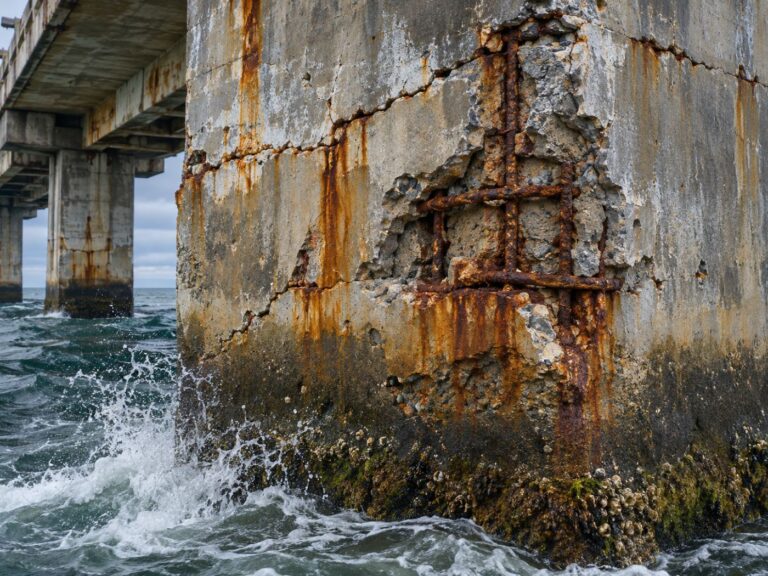
Most structure owners know the problem. There are more structures than inspection days. Statutory inspections follow fixed cycles, sensors cover the places where they were installed, and the rest of the portfolio waits for its turn. Meanwhile, concrete keeps carbonating, chloride keeps moving toward the rebar and foundations keep settling, a little at a time.
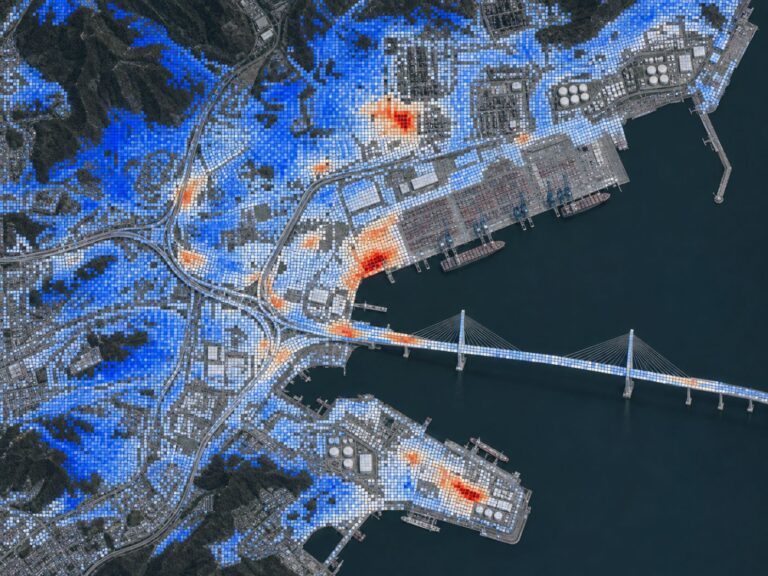
Virtual structural safety screening tries to fill that gap. Instead of starting with a visit, it starts with data that is already collected for the whole country every few days: radar satellite images, climate records and what you already know about each structure. Models turn that data into a first ranking.
Below we explain what goes into a virtual screen, what comes out, and what it should never be used for. If you are wondering whether a screening pilot makes sense for your portfolio, this is a good place to start.
Category: Technology
A virtual screen combines displacement, degradation and age
Structures fail in different ways, so a useful screen looks at more than one kind of evidence. In PILLAR we combine four drivers into one Structural Health Index from 0 to 100: durability (40%), InSAR displacement (30%), surface and steel condition (15%) and age compared with design life (15%).
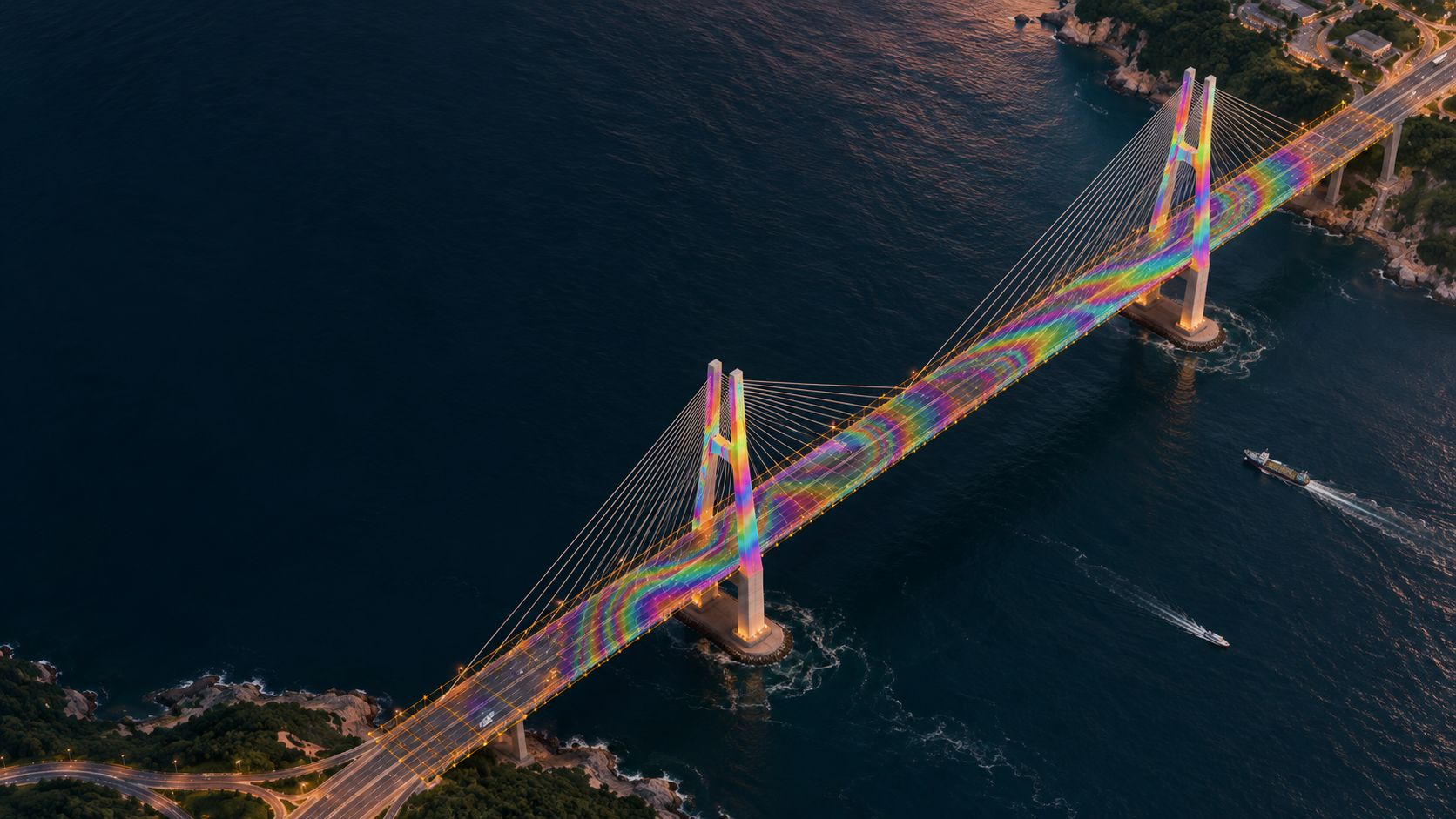
Displacement comes from radar satellites. InSAR compares images of the same place on different dates and turns small phase shifts into millimetres of movement. For each 80 m cell, PILLAR estimates a yearly settlement rate with its uncertainty and compares it with a screen for the structure type, such as 2 mm/yr and an angular distortion of 1/1000 for nuclear structures.
Degradation comes from engineering models. Carbonation, chloride ingress, corrosion and freeze–thaw all depend on climate, cover thickness and concrete quality. PILLAR runs published models with the site’s climate from ERA5 and samples the inputs 600 times, so the result is a range rather than a single number.
How a virtual screen is built
Satellite radar pairs and ERA5 climate for each structure zone.
Yearly settlement rates per 80 m cell, with uncertainty.
Carbonation, chloride and freeze–thaw with a 600-draw Monte Carlo.
A 0–100 index, an A–E grade and an action queue.
PILLAR workflow. Weights: durability 40%, InSAR 30%, surface 15%, age 15%.
The output is a priority list, not a verdict
A screen should answer one practical question: which structure, and which part of it, should we look at first? PILLAR sorts the portfolio from the lowest index upward and attaches the reasons. A bridge might rank high because chloride is close to the rebar; a dam might rank high because freeze–thaw cycles are frequent and the concrete is old.
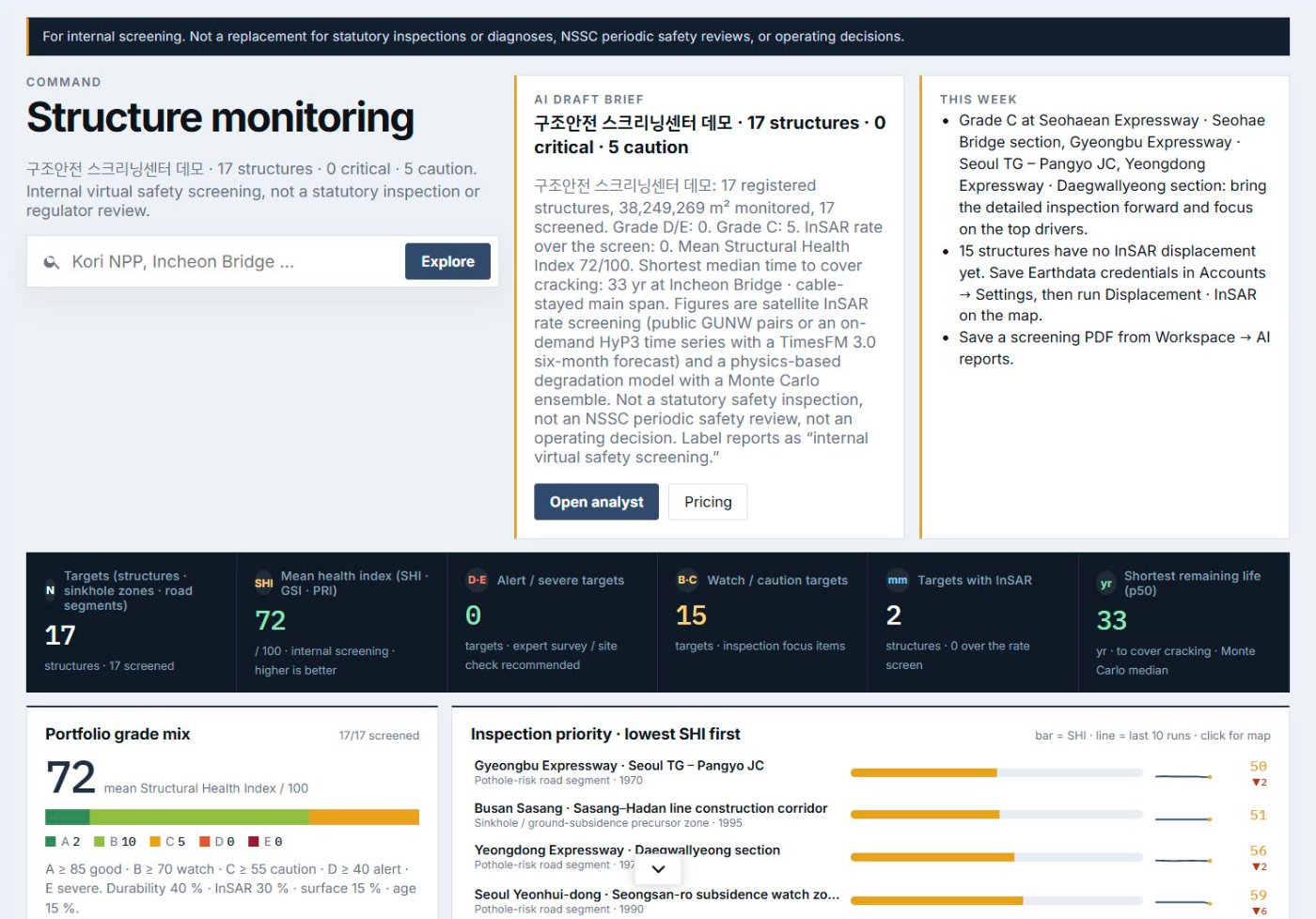
Grades run from A (good, 85 and above) to E (severe, below 40). A grade B structure might get a note to focus the next routine inspection on its top two drivers. A grade D structure gets a suggestion to arrange an expert survey. Each suggestion is a starting point for the inspection plan, not a replacement for it.
Virtual screening has a clear legal boundary
This point matters more than any model detail. A virtual screen is not a statutory inspection, a detailed safety diagnosis, a regulator’s periodic safety review or an operating decision. It cannot be, because it does not look at the structure up close and it relies on default values where real measurements are missing.
We design PILLAR so that every screen and every PDF carries that disclaimer. Licensed engineers do the diagnosis. The screen helps them and the owner spend their time where the evidence points.
Virtual screen vs. statutory inspection
Assess condition and safety grade
Decide where to look first
Site visit, tests, drawings
Satellite, climate, known attributes
Structures visited
Whole portfolio
Statutory
None: internal only
Where virtual screening helps most
Screening pays off where an owner manages many structures with different ages and exposures: a nuclear site with several safety-class buildings, a road agency with dozens of bridges, a water authority with dams in cold regions, or a local government with older retaining walls and road corridors.
It also helps before a structure exists. An SMR developer can start a displacement baseline during site preparation, so the same zone already has a history when the structure is commissioned.
So far we have explained what virtual structural safety screening is and where its limits are. You can see the five steps in more detail on the How it works page.
Frequently asked questions
Is virtual screening the same as structural health monitoring?
Not quite. Structural health monitoring usually means sensors installed on a structure. Virtual screening uses satellite and climate data to rank many structures, and can tell you where sensors would help most.
How accurate is it?
It depends on the data. InSAR improves with more pairs and stable surfaces; degradation results improve when measured cover, strength and chloride values replace defaults. PILLAR shows ranges, not single numbers.
Can the screening result be submitted to a regulator?
No. It is internal screening material. Statutory reports are prepared by licensed bodies.
Not sure which structure to inspect first?
We can start with a screening of your structures from public satellite and climate data.
Request a pilot →Edited and answered by the MomentCube PILLAR team / james@momentcube.com · +82-32-212-1011